Guides / Our own data
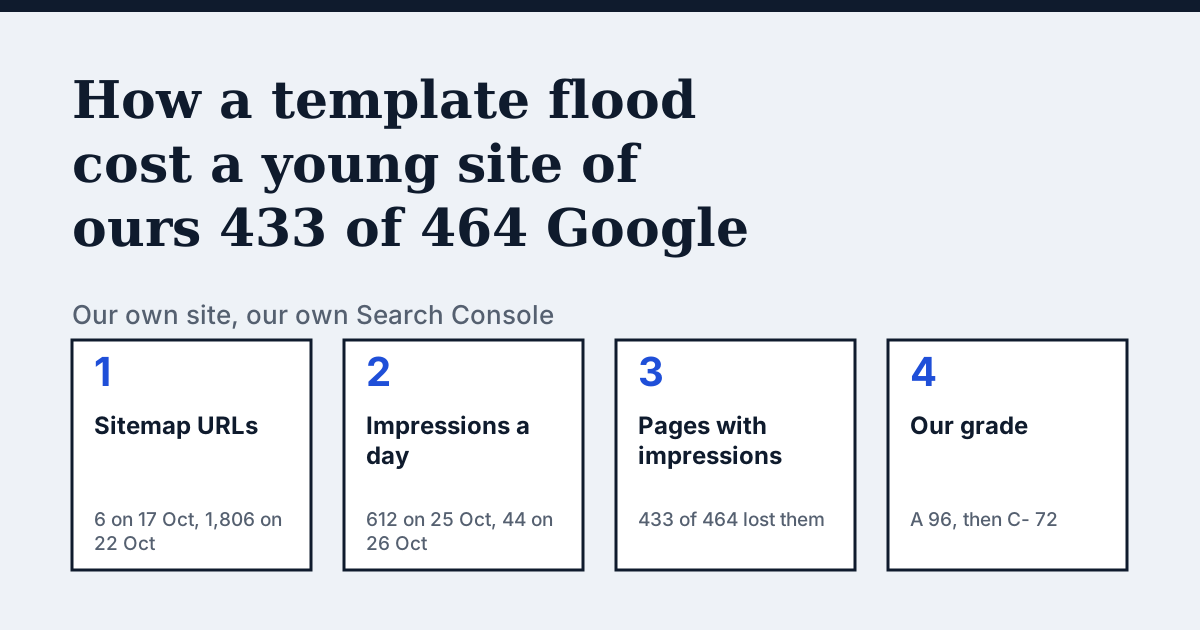
How a template flood cost a young site of ours 433 of 464 Google pages
What we did
The site is a young one of ours: its first release was on 14 October 2026. Between 17 and 22 October we put out one template of pages after another. Our own count of the sitemap was 6 URLs on 17 October and 1,806 on 22 October. It reached 2,183 on 27 October.
Our audit of 27 October read what those pages looked like:
- 1,463 of the URLs used one template, the question pages.
- Their median length was 412 words, and 44% to 58% of a page's text matched a sibling page.
- Every page carried the same paid-pack block.
- 106 of 180 sampled meta descriptions were the same sentence with a different number.
- The pages for one country-specific variant shared 78% of their text.
We also changed the site a lot while Google was still reading it. We rewrote titles and descriptions on those pages after launch and released several times a day. The sitemap's last-modified date moved with each release: 869 of the 1,439 sitemap URLs the 28 October crawl read carry the date 2026-10-27 (the next busiest day has 192), and we pinged IndexNow for 5,563 URLs in seven days.
What Search Console showed
For a week the curve looked like success. Impressions went from 2 a day on 17 October to 612 on 25 October, and the number of pages with at least one impression grew with it. Then it stopped.
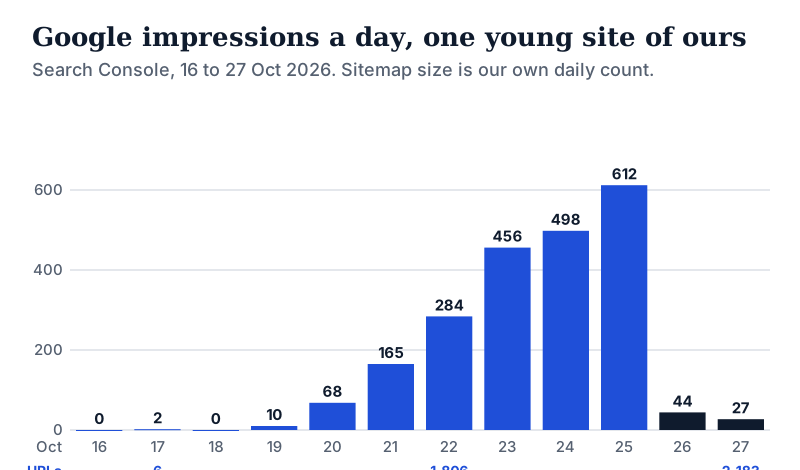
| Day (2026) | Sitemap URLs (our count) | Google impressions | Pages with impressions |
|---|---|---|---|
| 17 Oct | 6 | 2 | not read |
| 20 Oct | not read | 68 | 31 |
| 22 Oct | 1,806 | 284 | 119 |
| 23 Oct | not read | 456 | 224 |
| 24 Oct | not read | 498 | 219 |
| 25 Oct | not read | 612 | 259 |
| 26 Oct | not read | 44 | 30 |
| 27 Oct | 2,183 | 27 | 20 |
Search Console, Search results, read 28 October 2026. The same numbers are in the case CSV.
Counting distinct pages gives the figure in the title. 464 different pages had at least one impression on 23, 24 or 25 October. On 26, 27 and 28 October, 31 of them still had one and 433 (93%) had none. Most of those pages did not slip down the results; they stopped appearing at all.
The index report moved later than the impressions. We inspected the same 254 URLs, taken across every page group, through the URL Inspection API twice:
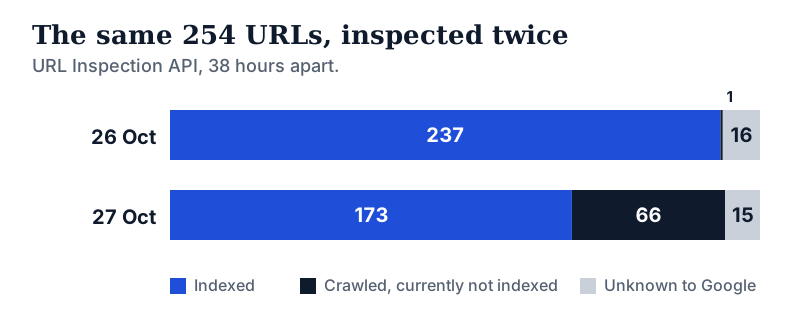
| Read | Indexed | Crawled, currently not indexed | Unknown to Google |
|---|---|---|---|
| 26 Oct, 01:45 UTC | 237 | 1 | 16 |
| 27 Oct, 15:24 UTC | 173 | 66 | 15 |
On 27 October the Manual actions page said "No issues detected". URL Inspection showed a successful fetch, indexing allowed and Google's canonical equal to ours. Googlebot, read from verified Google addresses in our logs, got HTTP 200 on every day from 19 to 27 October apart from one 504 on 22 October. We found no technical fault.
What we do not know
We cannot prove what caused it. The most likely cause is a site-wide quality reassessment of a 13-day-old domain with about 1,800 near-identical pages: the pattern, a cliff of more than 90% in a day with brand queries and pages still in the index, is the one other site owners describe after programmatic page floods (for example r/TechSEO 1xccp1n: about 8,900 to 300 impressions a day, as the poster reports). We changed pace, wording and dates at the same time, so we cannot say which one counted most. We have no run of the same site without the flood to compare against.
The three checks we wrote from it
After the drop we wrote three sitemap checks into our site audit. They are live in every crawl. On the 28 October crawl of that site all three fired:
| Check | What it reads | What it said on that site, 28 Oct |
|---|---|---|
template_flood, "Most of the sitemap is one template" | URL patterns with at least 100 sitemap URLs and 8% of the sitemap, where the pages we read share a median 25% or more of their text with their nearest sibling, at least three times what they share with other pages. A warning from half the sitemap. | 845 of 1,439 sitemap URLs (59%) are one template under a single URL prefix. The 845 pages we read share a median 39% of their text with the nearest page of the pattern, against 7% with other pages. |
sitemap_publish_spike, "Many sitemap URLs are dated the same day" | One day holding at least 150 dated URLs and 30% of the dated sitemap. A warning from 500 URLs and half. | 869 of 1,439 dated URLs (60%) carry 2026-10-27. |
index_likely_not, "Many sitemap pages will probably not be indexed" | An estimate: robots.txt blocks, noindex, canonical elsewhere, errors, near-duplicate pages and pages with almost no text, read from the pages we fetched per template and applied to the rest. A warning from 25% of the sitemap. | An estimated 441 of 1,439 sitemap URLs (31%) will probably not be indexed, from 1,192 pages read, all 441 near-duplicates of a sibling. |
Each check lists the page examples and the fix. We wrote these checks after the drop, with that site as the test case, so it is the one site we describe them on. The crawl of 26 October, before they existed, did not warn us.
Our own grades before and after
| Crawl of that site | Grade | Source |
|---|---|---|
| 26 Oct, before the three checks | A 96 | CSV |
| 27 Oct, three crawls the same day | A+ 100, then A 94, then C- 72 | CSV |
| 28 Oct, with the checks | C- 72 | CSV |
The site did not get worse between 26 and 28 October. The grade moved because we added checks. The 28 October report holds the grade at C- because the crawl found three signs that Google will not index much of the site, and it states that the score without that limit is 96 out of 100. The cap exists because a site can look clean page by page and still be one Google declines to index.
What we do now
On 28 October we cut the sitemap from 2,183 to 1,439 URLs and noindexed pages (the 28 October crawl lists 835 pages that cannot be indexed, mostly because of noindex). We have added or removed no URL since, and we plan to leave the site alone for 12 to 16 weeks. On our own sites we now hold these rules:
- At most 50 new indexable pages per site per week.
- The next batch only when 70% of the last one is indexed after 14 days.
- A template page goes live only with at least 60% of its text its own, and its own title and description.
- A page's last-modified date moves only when its main text does, and IndexNow is pinged for changed pages only.
- No title, slug or canonical change in a page's first 28 days.
Questions people ask
Why did my Google impressions drop overnight?
A drop of more than 90% in a day, with pages still in the index and no manual action, is what we saw and what other site owners report after publishing many near-identical pages. Check Search Console's Manual actions first, then how many URLs your sitemap gained in the last month and how much text each page shares with its sibling.
Does "Crawled, currently not indexed" mean Google found a fault?
No. It means Google fetched the page and chose not to index it. On that site the count of such pages in our fixed sample went from 1 to 66 of 254 between two reads 38 hours apart.