Guides / Brand checks
ChatGPT visibility dropped to zero from one date. What changed?
A block can come back with the next deploy. The Starter plan checks every day that AI crawlers can still get in and mails the exact fix when one is shut out. €19 a month. It does not read ChatGPT's answers.
Our data, 23 Oct 2026: of 10,426 popular EU sites, 1 in 13 (7.9%) blocked at least one AI search crawler (OAI-SearchBot, Claude-SearchBot or PerplexityBot) in robots.txt. Source: AI access index.
Explanation written with AI from the official source cited on this page.
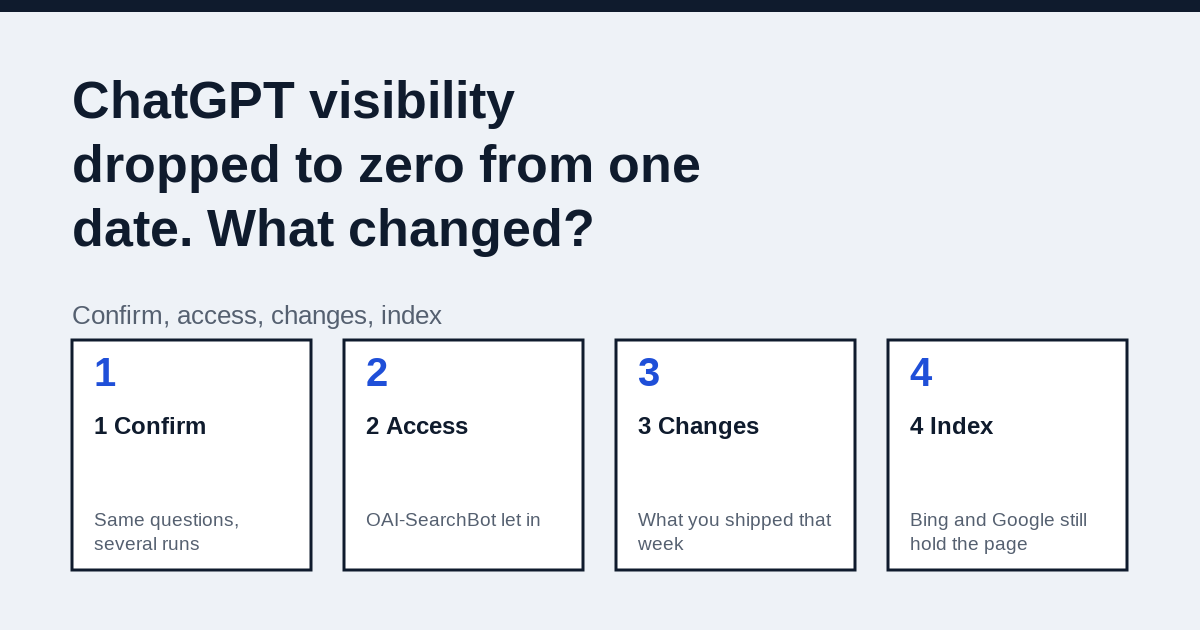
Look first for something that changed on that date: how the answers are measured, your site, or the index. Confirm the drop over several runs, then check that OAI-SearchBot can still fetch your pages through robots.txt and your CDN or firewall, list what you shipped that week, and check that Bing still holds the pages.
Is it really zero?
A tracking tool asks a fixed set of prompts and reports what came back. Before you look for a cause, ask a few of the same questions yourself, logged out, in new chats, at least five times over three days, and write down who is named. Answers move from run to run. In our 14 October 2026 study, 24 buyer questions asked twice each (a method we have since retired), a question's first and second answer linked the same shop sites only 40% to 61% of the time, on average per niche (our study: French-language questions in three shop niches).
Also ask the tool whether it changed how it collects answers around that date: the model it queries, the country, logged in or out. A change in how the answers are measured looks the same on a chart as a change in the answers.
Four checks, in this order
- Access in robots.txt. OpenAI's crawler page says: "Sites that are opted out of OAI-SearchBot will not be shown in ChatGPT search answers, though can still appear as navigational links." In your robots.txt, look for a
User-agent: OAI-SearchBotgroup, or aUser-agent: *group withDisallow: /when there is no OAI-SearchBot group (that is the group rule of RFC 9309). The AI crawler checker reads the file and shows what your server answered for each crawler. If you keep the file in git, look at its history around the date. - Access at the CDN or firewall. robots.txt can allow a crawler that the firewall then refuses. Check your CDN's bot settings, then search your server logs for
OAI-SearchBotin the user agent on and after the date and note the status code each request got. OpenAI publishes the IP ranges of OAI-SearchBot at openai.com/searchbot.json, linked from its crawler page, so you can tell its requests from fakes that copy the name. If the real requests get 403 or a challenge page from that date on, or stop arriving at all, you have found a cause you can see and fix. - What you shipped that week. A redesign, a move to a new framework, new URLs or a new robots meta tag can each take pages out of reach. Load a key page with JavaScript switched off: text that is drawn in by scripts is missing for any crawler that does not execute them. Look for a
noindexthat came with a template, and for old URLs that now return 404 instead of a redirect. - The search index. Check that search engines still hold the pages: inspect them in Bing Webmaster Tools and Google Search Console. If they dropped out of either index around the same date, that is a lead worth fixing.
If one of these checks fails on the date of the drop, you have a cause you can see and fix. Fix it, then re-count on the same questions.
If nothing changed on your side
Then the change is in the answers. Look at who ChatGPT names now for the questions you lost, open the pages it links and note what they state in plain text that yours does not. We have not measured which of those traits decide who gets named, so treat the list as gaps to test, not as proof. Track it as "named in x of n runs" on the same questions each week, and be wary of anyone who promises the mentions back by a date.
A second count helps here. A business verified in OpenAI's Business Hub (since 10 November 2026) sees its own ChatGPT mentions and website clicks, so you can set OpenAI's figure beside your tracker's for the same weeks.
The faster way
The €49 audit lists every page AI crawlers cannot reach or read on your site, with the fix for each.
Questions people ask
Our tracker shows zero but we still see ourselves in ChatGPT. Which is right?
Both can be. The tracker asks its fixed prompts in its own setup; you asked in yours. Count over several runs on the same questions in one setup, and compare like with like.
Does blocking GPTBot remove us from ChatGPT search?
Not by itself, according to OpenAI: its crawler page lists GPTBot (training) and OAI-SearchBot (search) separately and says each setting is independent of the others. A block on OAI-SearchBot is the one that keeps a site out of ChatGPT search answers.
How long until we come back after a fix?
Nobody can give a reliable number. OAI-SearchBot has to fetch the pages again, the index has to pick them up, and answers vary between runs anyway. Note the date of the fix and count again on the same questions after a few weeks.
Sources
- OpenAI: crawlers overview (GPTBot, OAI-SearchBot, ChatGPT-User)
- RFC 9309: Robots Exclusion Protocol
- CitedBy: AI access index, 10,426 EU sites (23 Oct 2026)
- CitedBy: 48 ChatGPT answers to 24 buyer questions (14 Oct 2026), method and CSV
- OpenAI: introducing ChatGPT for businesses
- About CitedBy: how we count