Guides / Guide
How do I get my Shopify store recommended by ChatGPT?
Want every page checked, not only access? The CitedBy audit crawls your store up to your plan's page limit and gives the exact fix for each issue. €49 audit, paid once, 14-day money-back guarantee. It does not read ChatGPT's answers.
Our data, 24 Nov 2026 (2026-11-24): 30 Shopify stores read as a crawler reads them, 29 of them readable. Source: CSV, method below.
Explanation written with AI from the official source cited on this page.
Nobody can make ChatGPT recommend a store, but you control what its crawlers can read. On Shopify the defaults are open: in our read of 29 well-known stores, none blocked an AI search crawler in robots.txt. Your work is the product text in the HTML, Organization and Product data, and a clean firewall.
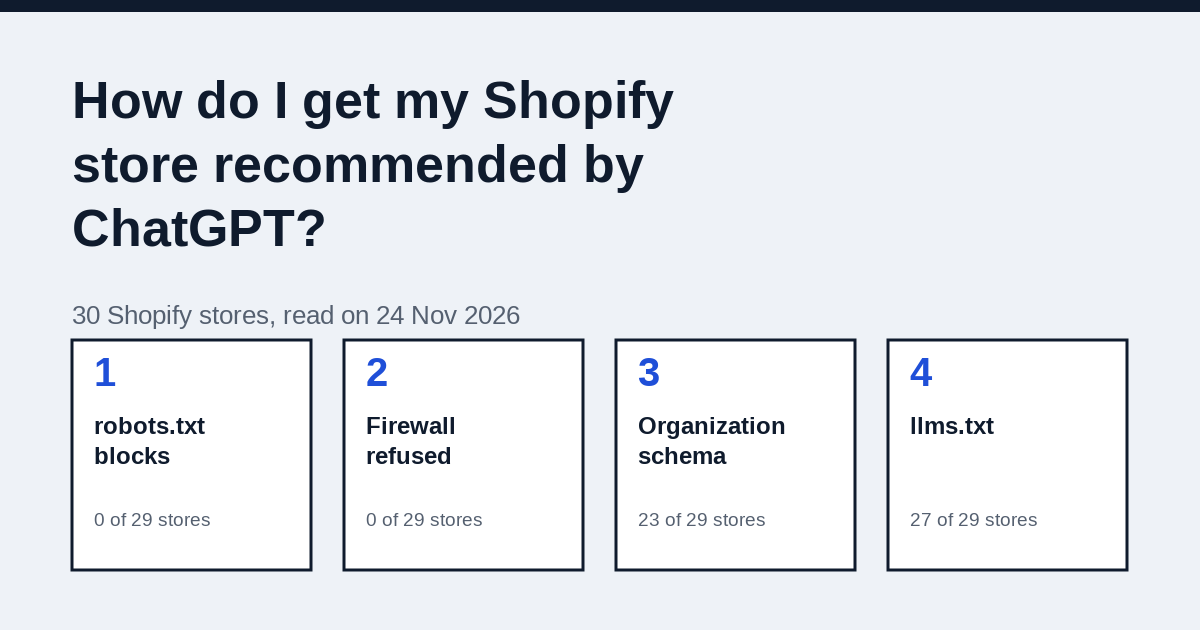
What 30 Shopify stores look like to a crawler
On 24 Nov 2026 we fetched the home page and up to 9 more pages of 30 Shopify stores as CitedBot and sent one live request per AI crawler. 29 stores gave a readable home page. Sites we could not read are left out of every count.
| What a crawler finds | Sites | Share |
|---|---|---|
| robots.txt blocks at least one of GPTBot, OAI-SearchBot, ClaudeBot, Claude-SearchBot, PerplexityBot | 0 of 29 | 0% |
| robots.txt blocks a search crawler (OAI-SearchBot, Claude-SearchBot, PerplexityBot) | 0 of 29 | 0% |
| Home page turned away a live request with one of those five user agents (firewall) | 0 of 29 | 0% |
| Home page has under 100 words of text in the HTML it sends | 1 of 29 | 3% |
| Home page has JSON-LD that parses | 20 of 29 | 69% |
| Home page has Organization or business-type JSON-LD | 23 of 29 | 79% |
| sitemap.xml present and valid | 29 of 29 | 100% |
| llms.txt present | 27 of 29 | 93% |
The stores in this sample are the ones "best Shopify stores" lists name, so they are well-known brands and mostly well kept. Read the table as what a good Shopify store looks like to a crawler, not as an average.
The five fixes, in order
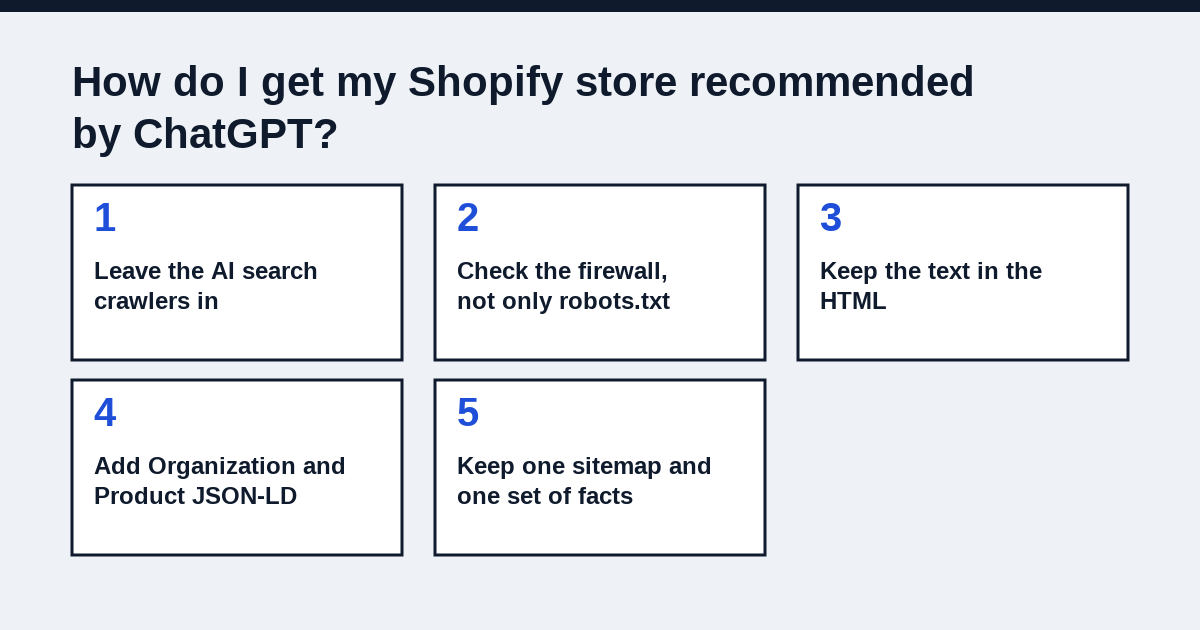
- Leave the AI search crawlers in. Shopify's default robots.txt allows crawlers it does not name, so a block is something added in a robots.txt.liquid theme template; check yours has none for OAI-SearchBot, PerplexityBot and Claude-SearchBot. Shopify's help page says a block there affects only open-web discoverability, because product data reaches agentic storefronts through Shopify Catalog independently of /robots.txt. Our Shopify page has the steps and the lines.
- Check the firewall, not only robots.txt. 0 of 29 stores turned away a live request with one of the five user agents. If a security app or CDN rule sits in front of your store, a live request is the only way to see it.
- Keep the text in the HTML. 1 of 29 of the home pages had under 100 words without JavaScript. If your theme or an app draws descriptions with scripts, a crawler that does not run them reads an empty page.
- Add Organization and Product JSON-LD. 23 of 29 home pages had Organization or a business-type entity. Product data (name, price, availability) is what an assistant reads when it compares shops. Google documents the Organization properties; we did not measure Product data on this page.
- Keep one sitemap and one set of facts. 29 of 29 had a valid sitemap.xml. Shopify generates it; make sure the prices and shipping lines in the HTML match your product feed and policy pages.
llms.txt: 27 of 29 of the stores serve one. It is optional, and there is no good evidence that the large assistants read it.
How we measured
- Sample: stores named in three public "best Shopify stores" lists (websiteplanet.com, firstsiteguide.com, printful.com), read on 24 Nov 2026, in list order, first 30 whose home page carries Shopify's signature (cdn.shopify.com or Shopify.theme). A store that redirected elsewhere or returned an error was replaced by the next name. These are well-known brands, a biased sample.
- Fetched: 24 Nov 2026, CitedBot/1.0, robots.txt obeyed, no JavaScript, one request a second per site, home page plus up to 9 pages, /sitemap.xml, /llms.txt, then the home page once per crawler with its published user-agent string. A 403 to those strings can differ from what the real crawler gets.
- Not measured: whether any assistant recommends any of these stores, sales, and what a browser shows after JavaScript. Store names are not published; the CSV has one anonymised row per store.
- Checked by hand: 12 random rows, drawn from the 150 rows of our five 24 Nov 2026 crawls (30 sites each; this page's 30 stores are one of the five), were re-fetched with curl later that day and compared on llms.txt, sitemap.xml, JSON-LD and word count: 11 of 12 matched on all four, 1 (a news site, not one of these stores) returned 403 to the second fetch although it answered the crawl. More than 1 mismatch in 10 would have held the page.
Questions people ask
Does Shopify block ChatGPT by default?
No. Shopify's default robots.txt allows crawlers that are not named, per its help page (read 21 Oct 2026). A block exists only if you or an app added one in robots.txt.liquid.
Where do I change robots.txt on Shopify?
In the theme's robots.txt.liquid template, which Shopify documents but does not support. Our Shopify page lists the steps and what a block does and does not change.
Can I pay to be recommended by ChatGPT?
This guide covers what a crawler can read on your own store. It does not cover paid placement, and no fix here promises a recommendation. Count how often you are named: ask your buyers' questions twice in each assistant, with web search on.
Sources
- Shopify Help Center: Editing robots.txt.liquid, read 21 Oct 2026
- Shopify.dev: Customize robots.txt.liquid, read 21 Oct 2026
- OpenAI: crawlers and user agents, read 24 Nov 2026
- Google: Organization structured data, read 24 Nov 2026
- CitedBy methodology